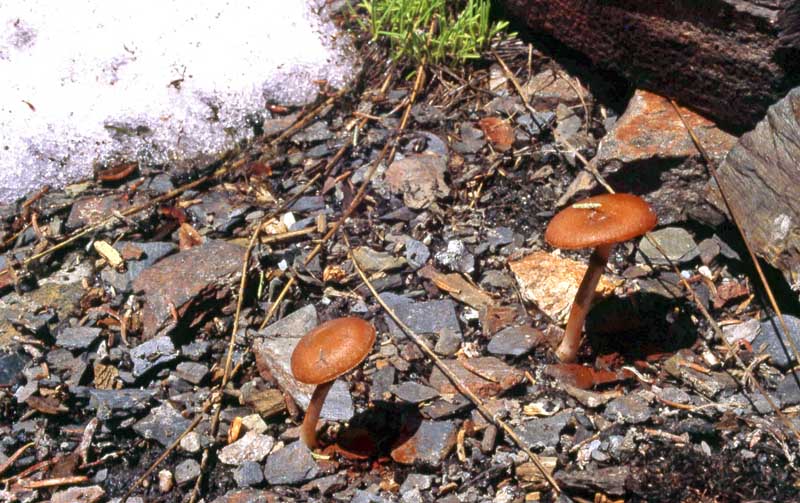
© Andrew Parker
Danny’s DNA Discoveries – Crassisporium of the PNW
by Danny Miller
|
|
Danny’s DNA Discoveries – Crassisporium of the PNW
|
|
Introduction
Some spring to summer burn "Pholiota" have long been known to be different because of their dry caps, reddish-brown spore print and thick spore walls, so they were placed in Pachylepyrium. Recent genetics showed that our species is quite different not only from Pholiota, but also from other Pachylepyrium, so a new genus (and eventually family) were erected for it and a couple other close relatives around the world - Crassisporium. And now we are discovering a second species that may need a new genus/family of its own. abundant common uncommon rare - colour codes match my Pictorial Key and are my opinions and probably reflect my bias of living in W WA. Rare species may be locally common in certain places at certain times. Crassisporium funariophilum EU (='Pachylepyrium' carbonicola EU, ='Pholiota' subangularis ID) - True "Pholiotas" found in burn sites don't have a dry cap, don't have the reddish tint to the brown spore print nor thick walled spores, and are not usually restricted to the spring and summer. Formerly called Pachylepyrium carbonicola. ITS DNA of the newer Idaho species Pholiota subangularis is only a couple of bp different than the EU type sequence of Crassisporium funariophilum, and now that local species is considered to be the same. Crassisporium sp. 'BC01' - one BC and one OR collection are a sister species, unknown until discovered through DNA.
Crassisporium funariophilum © Terri Clements and Donna Fulton
This next species is further distant than Romagnesiella is from Crassisporium and even LSU sequences cannot place it to family. It is close to Crassisporium pakistanicum n.p., but that was given a provisional name based on ITS only so I don't trust that it is actually in Crassisporium either. Agaricineae sp. 'PNW01' - unknown family in the Agaricineae. One of the four collections did not appear to be near any burned material, so I don't know if this species is obligate with burned wood or not. It certainly resembles Crassisporium. Three of the four collections were spring/summer, just like Crassisporium s.s., but one collection was fall.
Agaricineae sp. 'PNW01' © Yi-Min Wang (3 images) |


